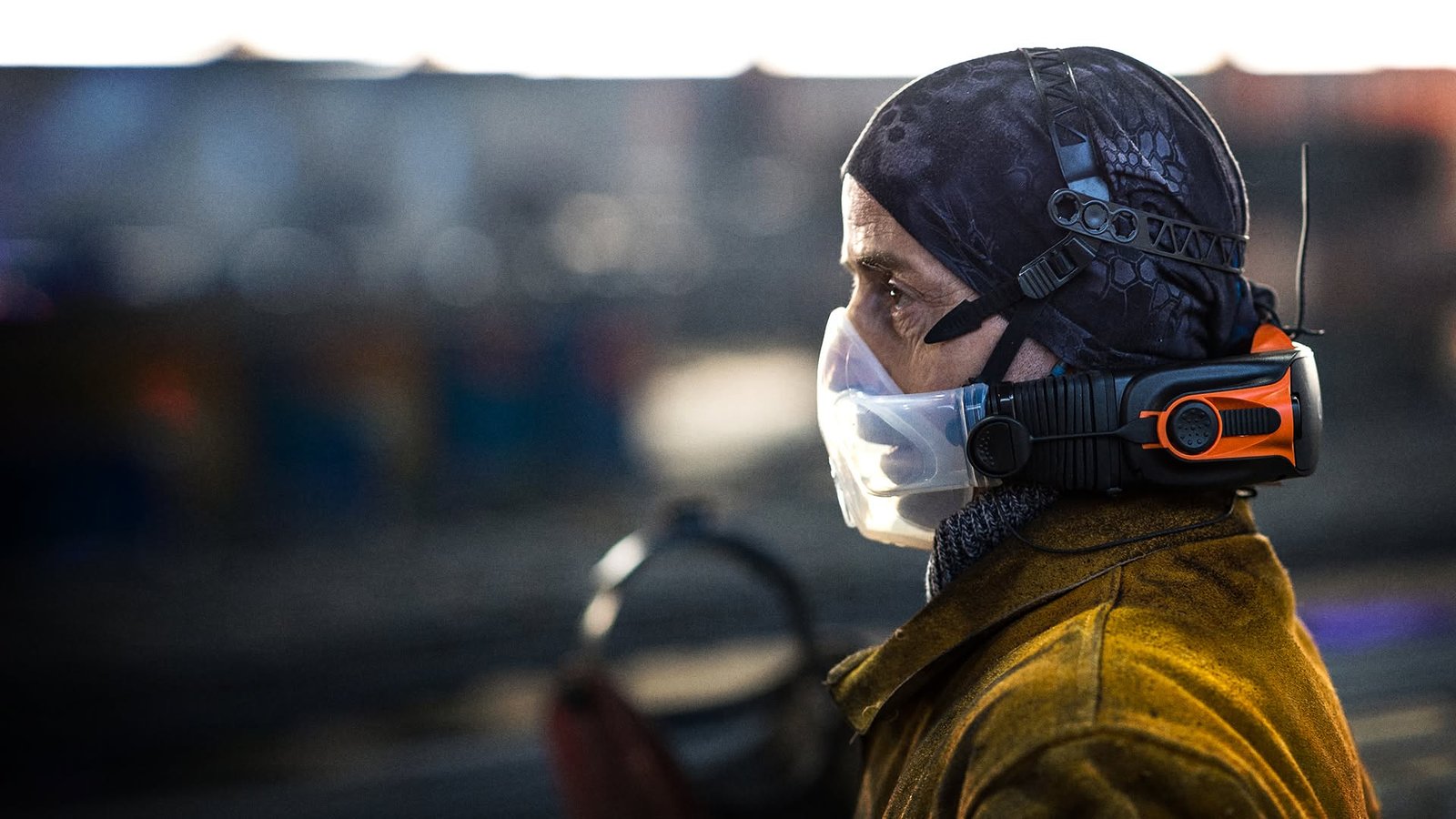
A CleanSpace respirator only protects your people if it is matched to the hazard they face. Even a well-made respirator leaves workers exposed if it cannot filter what is actually in the air, or if it cannot be worn properly for a full shift.
That is why we always start with one question: what is in the air on your site? This guide explains how disposable masks and powered air-purifying respirators (PAPRs) differ, then shows which CleanSpace respirator fits four common Thai worksite hazards.
Disposable masks vs. PAPRs: the core difference
Disposable respirators such as N95 or FFP2/FFP3 masks are negative-pressure devices. The wearer’s own breathing pulls air through the filter material. They only work as intended when the edges seal tightly against the face, because air always takes the path of least resistance. Any gap around the nose, cheeks or chin lets unfiltered air in.
A powered air-purifying respirator (PAPR) works the other way round. A small battery-powered fan draws air through a filter and delivers it into the mask, creating positive pressure. If a tiny leak does occur, air tends to flow outwards rather than contaminated air flowing in.
In practice this matters most on hot, humid worksites, which describes much of Thailand. Disposable masks get hot and wet, breathing resistance rises as filters load with dust, and workers start loosening straps or lifting the mask between tasks. Every time they do, protection drops. A PAPR delivers a steady flow of cool, filtered air, which makes it far easier for people to keep wearing it correctly.
Why a CleanSpace respirator beats a disposable mask in Thai heat
Conventional PAPRs have a reputation for being heavy, bulky and awkward: a belt-mounted battery pack, a hose and a lot of cleaning effort. CleanSpace respirators were designed to remove those drawbacks:
- No hose, no belt, no waist-mounted battery pack. The whole system sits on the head and face.
- Lightweight. CleanSpace describes its units as weighing under 450 grams.
- AirSensit breath-responsive technology. Airflow adjusts to the wearer’s breathing instead of running at a fixed rate.
- High filtration. P3 particulate filters achieve filtration efficiency of up to 99.97%.
- Recognised approvals. The platform carries approvals and ratings including EN 12942, NIOSH, AS/NZS 1716, IECEx/ATEX (for the EX model) and an IP66 rating on selected units. Exact certification depends on the model, mask and filter combination.
A quick note on fit: CleanSpace offers half masks and full face masks, which are tight-fitting facepieces. That means facial hair, fit testing and mask size all still matter. Requirements differ by product, so we confirm them with you before you commit.
1. Which CleanSpace respirator for welding fumes?
Typical situations: metal fabrication and welding, grinding and metal particulate, stainless steel and alloy welding fume, and confined-space welding in shipyards and workshops.
Welding fume is a fine, hot, fast-moving particulate. Stainless steel and alloy welding in particular can release fume containing metals such as chromium and manganese. Confined spaces make things worse because fume builds up quickly and ventilation is limited.
Welders also need respiratory protection that is comfortable under a helmet and does not add breathing resistance. A lightweight, head-mounted PAPR with a P3 particulate filter suits this work, and CleanSpace WORK is built for high-dust workplaces such as welding. It is designed to pair with common welding headgear, and we can confirm compatibility with your specific helmet.
Check before you buy: if your process also produces gases or vapours, you will need the correct combined filter, not a particulate filter alone.
2. Which CleanSpace respirator for construction dust and silica?
Typical situations: cutting, grinding and demolition dust; respirable crystalline silica; stone, cement and concrete handling; woodwork, cutting, sanding and timber.
The most serious construction hazard is often the one you cannot see. Cutting or grinding concrete, stone and cement releases respirable crystalline silica, microscopic particles that can reach deep into the lungs and are linked to serious, irreversible lung disease. Wood dust is another common hazard, and it also builds up quickly during sanding and cutting.
For most dusty construction and woodworking tasks, CleanSpace WORK gives a lightweight, practical option. For wet or tougher conditions, such as stone cutting, jobs where equipment is washed down, or long shifts, a unit with IP66 protection and longer battery life, such as CleanSpace CST PRO or CST ULTRA, is worth considering. The ULTRA can be used with a full face mask, which also protects the eyes from dust.
3. Which CleanSpace respirator for fire and emergency support?
Typical situations: wildfire smoke exposure (PM2.5 and particulate), post-incident overhaul and site clean-up, HazMat and disaster-response support roles, and structural fire support for non-entry, non-IDLH tasks.
Smoke contains very fine particles, and Thailand’s annual burning season brings prolonged PM2.5 exposure for crews who spend long hours outdoors. Clean-up after an incident also exposes workers to ash, soot and debris long after the flames are out.
A CleanSpace PAPR can protect support crews working in these conditions with the correct particulate or combined filter.
Important limits: CleanSpace respirators are air-purifying devices. They are not designed for oxygen-deficient atmospheres, IDLH (immediately dangerous to life or health) conditions, or interior structural firefighting, where supplied-air breathing apparatus is required. Tell us exactly what your team does, and we will tell you whether a PAPR is the right tool.
4. Which CleanSpace respirator for oil & gas?
Typical situations: potentially explosive atmospheres (ATEX/IECEx zones), refinery and petrochemical processing, offshore and onshore rig operations, and confined-space maintenance in processing plants.
In these environments the respirator itself must not become a source of ignition. That requirement is non-negotiable: if there is any risk of an explosive atmosphere, only an intrinsically safe, certified unit is appropriate.
CleanSpace EX is an intrinsically safe PAPR certified to IECEx and ATEX for potentially explosive environments. It pairs with half masks and filters designed for the EX system. As always, the right filter depends on the contaminants on your site, and the zone classification must be confirmed before use.
Quick selection guide
| Your hazard | Recommended CleanSpace respirator |
|---|---|
| Welding and metal fume | CleanSpace WORK (with the correct filter and headgear) |
| Construction dust, silica, wood dust | CleanSpace WORK, or CST PRO / CST ULTRA for long or wet conditions |
| Smoke and clean-up support (non-IDLH) | CST range with the appropriate particulate or combined filter |
| Explosive atmospheres | CleanSpace EX |
| Healthcare, laboratory, pharmaceutical | CleanSpace HALO |
Four questions help narrow the choice:
- What is the hazard? Dust, fume, smoke, explosive atmosphere or a biohazard.
- How long and how demanding is the shift? Heat, humidity and washdown affect run time and the IP rating you need.
- Is intrinsic safety required? If so, only an EX-certified unit will do.
- What mask suits your workforce? Half mask or full face, and compatibility with glasses, helmets and other PPE.
Not sure which CleanSpace respirator fits your site?
Send us your hazard, shift pattern and number of workers, and our team will recommend a specific configuration, including power unit, mask size and filter, before you request a quote. As the official CleanSpace distributor in Thailand, Air Repair can also supply replacement filters, masks and spares locally.
Talk to a CleanSpace specialist | Explore CleanSpace in Thailand